What Happened Once Is Happening Again
What happened to the world's ozone hole?
(Paradigm credit:
Getty Images
)
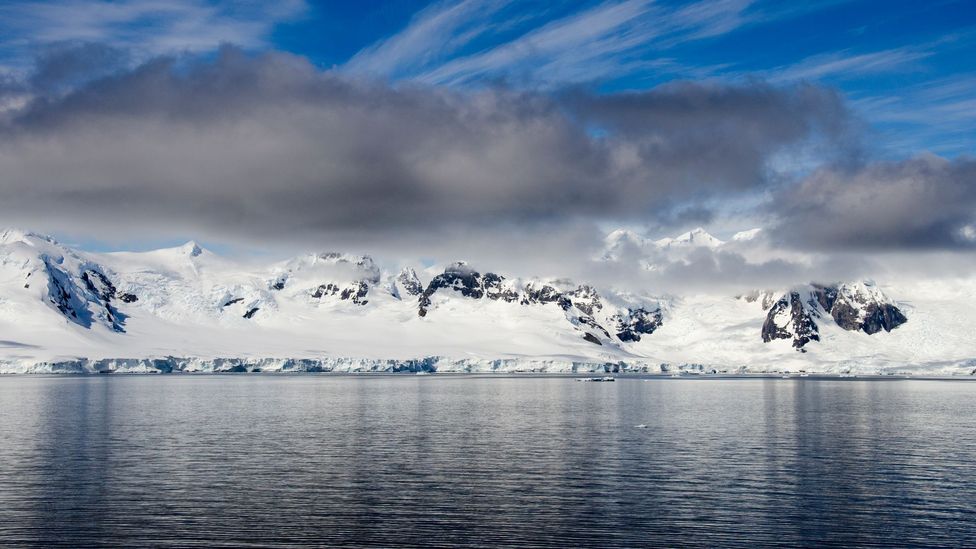
Dorsum in the 1990s, the hole in the planet'south ozone layer was a pressing global crisis – if we had ignored it, today there would be several.
I
In the tardily 1970s, Jonathan Shanklin, a meteorologist with the British Antarctic Survey, spent much of his time tucked away in an office in Cambridge working through a backlog of data from the southernmost continent on our planet.
Shanklin was responsible for supervising the digitisation of paper records and computing values from Dobson spectrophotometers – ground-based instruments that mensurate changes in atmospheric ozone.
As the years passed, Shanklin started to see that something was going on – after well-nigh two decades of fairly abiding measurements, he noticed that ozone levels began dropping in the late 1970s. Initially, Shanklin's bosses weren't every bit certain as he was that something was happening, which frustrated him.
By 1984, the ozone layer over Antarctica's Halley Bay research station had lost one-third of its thickness compared to previous decades. Shanklin and colleagues Joe Farman and Brian Gardiner published their findings the following year, suggesting a link to a human-made compound called chlorofluorocarbons (CFCs), used in aerosols and cooling devices. Their discovery, the thinning of the ozone layer over Antarctica, came to exist known as the ozone hole.
As news of the discovery spread, alarm rippled around the globe. Projections that the destruction of the ozone layer would adversely bear upon the health of humans and ecosystems sparked public fearfulness, mobilised scientific investigation and galvanised the world'southward governments to collaborate in an unprecedented fashion.
You might likewise like:
- The bloodshot story of how we stopped acrid rain
- How to fight microplastic pollution with magnets
- The strange deal that created a ghost town
Since its heyday, the story of one of the gravest environmental problems that humanity has faced has largely fallen from the radar.
More than xxx years on from its discovery, what ever happened to the pigsty in the ozone layer?
A vital phenomenon
Ozone is more often than not constitute in the stratosphere, a layer of the atmosphere between six and thirty miles (x-50 km) higher up the Earth's surface. This ozone layer forms an invisible protective shield over the planet, absorbing damaging UV radiation from the dominicus. Without information technology, life on Earth would non be possible.
The British Antarctic Survey first began measuring ozone concentrations above Antarctica in the 1950s. But several decades passed before it became articulate there was a trouble.
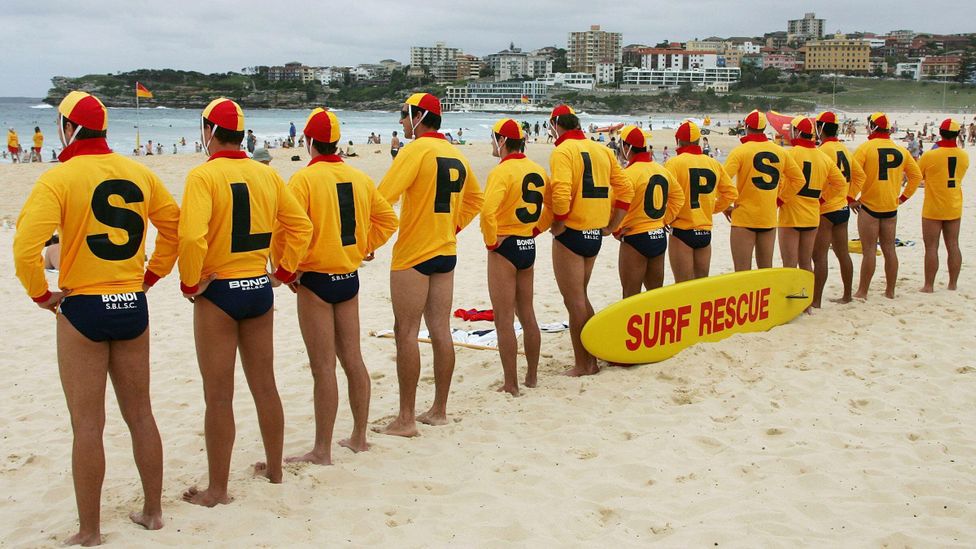
Australia launched the public health campaign "slip, slop, slap" in response to the ozone hole, which reminded people to encompass upwardly, vesture suncream and seek out shade (Credit: Alamy)
In 1974, scientists Mario Molina and F. Sherry Rowland published a newspaper theorising that CFCs could destroy ozone in Earth's stratosphere. Until and then CFCs were thought to exist harmless, but Molina and Rowland suggested that assumption was wrong. Their findings were attacked past manufacture, who insisted their products were safe. Amongst scientists, their research was contested. Projections indicated that ozone depletion would exist small – betwixt 2-4% – and many thought information technology would happen on a timescale of centuries.
The use of CFCs continued unabated and by the 1970s they were ubiquitous worldwide, used as coolants in refrigerators and air conditioners, in aerosol spray cans and every bit industrial cleaning agents.
A mere decade later, in 1985, the British Antarctic Survey confirmed a hole in the ozone layer and suggested a link to CFCs – vindicating the work of Molina and Rowland, who were somewhen awarded the 1995 Noble Prize in chemistry. Fifty-fifty worse, the depletion was happening much quicker than had been anticipated. "It was actually quite shocking," says Shanklin, at present an emeritus young man at the British Antarctic Survey.
From and so on, scientists raced to figure out how and why this was happening.
A chemic mystery
In 1986, as the Antarctic winter neared its cease, Susan Solomon, a researcher with the US government National Oceanic and Atmospheric Administration, led a squad of scientists to McMurdo Base in search of answers. At the fourth dimension, scientists were debating 3 possible theories, one of which Solomon had proposed: that the answer might lie in surface chemistry involving chlorine on polar stratospheric clouds, which occur at loftier latitudes and only grade during very depression temperatures in polar winter.
"It was a great mystery," says Solomon, now professor of atmospheric chemistry and climate science at MIT. Her research explained how and why the ozone hole occurs in Antarctica. "All the data pointed towards the combination of the increment of chlorine from the man apply of CFCs and the presence of polar stratospheric clouds as being the trigger for what happened."
Satellite monitoring confirmed ozone depletion extended over a vast region – 7.vii one thousand thousand square miles (20 meg sq km).
The serious threat posed by ozone depletion – rises in skin cancer and cataracts in humans, damage to institute growth, agricultural crops and animals and reproductive bug in fish, crabs, frogs and phytoplankton, the basis of the marine nutrient chain – spurred international action and collaboration.
But considering how grave a threat the ozone pigsty was deemed to exist, why do we non oft hear well-nigh it anymore?
"It'southward not the same cause for alert that it once was," says Laura Revell, associate professor of environmental physics at the University of Canterbury, New Zealand. This is largely due to the unprecedented international steps that governments took to tackle the problem.
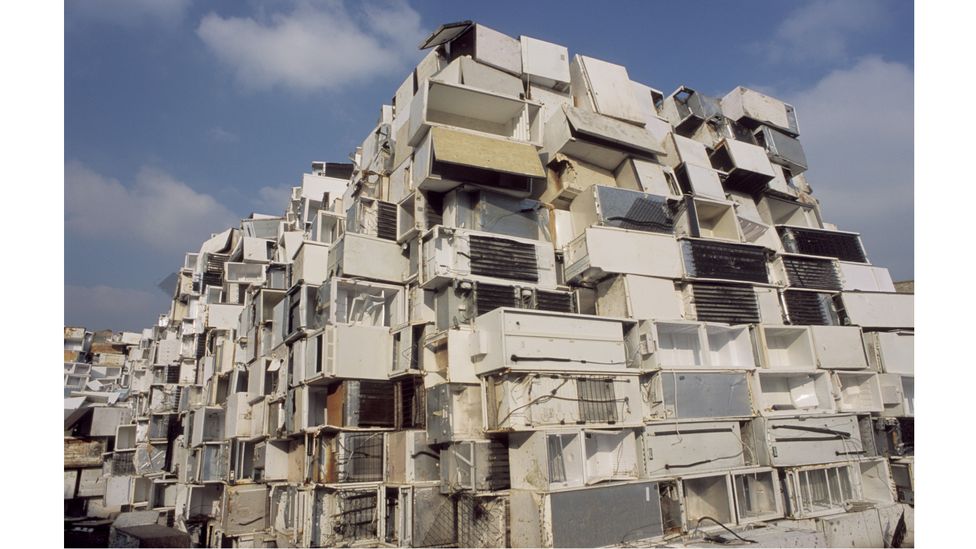
Fridges manufactured before 1995 contained Cfc refrigerants, which – together with other ozone-depleting substances – were responsible for the ozone hole (Credit: Getty Images).
Thinking ozone depletion would be modest and far into the future, international policymakers initially took a cautious approach to ozone protection. In 1977, a global activity plan was adopted, calling for monitoring of ozone and solar radiation, research on ozone depletion's effect on human health, ecosystems and the climate and a cost-benefit assessment of control measures. A few months before the discovery of the ozone pigsty by the British scientists, this led to the 1985 Vienna Convention, calling for further enquiry. But it didn't include legally bounden controls for Cfc reduction, disappointing many.
Afterward the ozone hole discovery, heavy investment in scientific research, marshalling of economical resources and coordinated international political action helped to plough things effectually.
In 1987, the Montreal Protocol was adopted to protect the ozone layer by phasing out the chemicals which deplete it. To support compliance, the treaty recognised "common but differentiated responsibilities", staggering phase-out schedules for developed and developing countries and establishing a multilateral fund to provide fiscal and technical assistance to assistance developing countries meet their obligations.
During the 1990s and early-2000s, the production and consumption of CFCs was brought to a halt. By 2009, 98% of the chemicals agreed to in the treaty had been phased out. Six amendments — which the treaty allows when scientific evidence shows farther activeness is needed — have led to e'er-tightening restrictions on substances introduced to supercede CFCs, such equally hydrochlorofluorocarbons (HCFCs) and hydrofluorocarbons (HFCs). While good for the ozone layer, these replacements turned out to be bad for the climate. The global warming potential of the well-nigh usually used HCFC, for example, is near 2,000 times stronger than carbon dioxide.
The treaty's climate benefits have been a positive side effect. In 2010, emissions reductions due to the Montreal Protocol were betwixt 9.7 to 12.5 gigatons of CO2 equivalent, approximately five to six times more than the target of the Kyoto Protocol, an international treaty adopted in 1997 that aimed to reduce greenhouse gas emissions. The 2016 adoption of the Kigali Amendment, which volition limit the utilise of HFCs, volition help avoid upwardly to 0.5 C of global warming by 2100.
"You could argue [the Montreal Protocol] is a much more than successful bit of climate protection legislation than any of the other [climate] agreements we've had to engagement," says Revell.
Since its adoption, the Montreal Protocol has been signed by every country on Earth – to appointment the only treaty to exist universally ratified. It's widely considered a triumph of international ecology cooperation. According to some models, the Montreal Protocol and its amendments accept helped forbid up to two meg cases of peel cancer yearly and avoided millions of cataract cases worldwide.
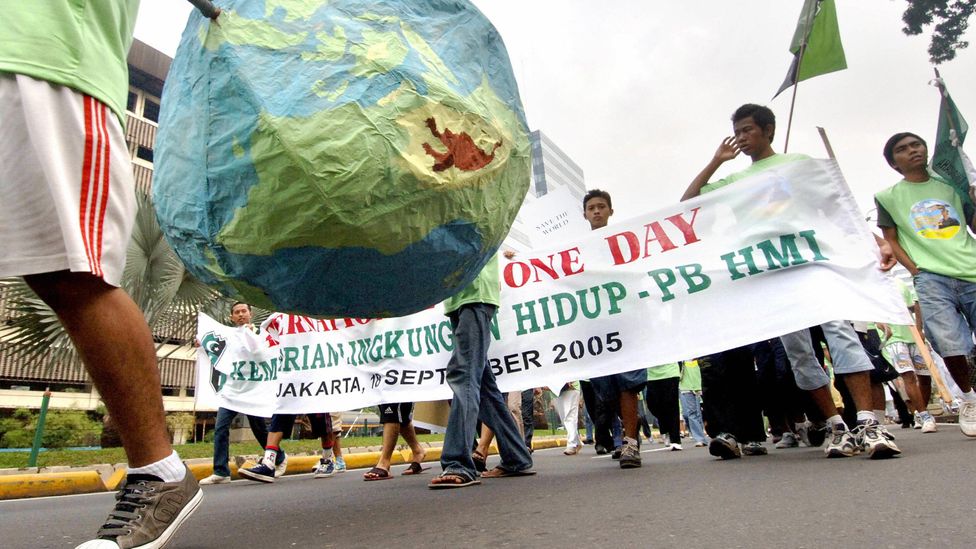
The ozone crisis required humanity to work together (Credit: Getty Images)
Had the world not banned CFCs, nosotros would now find ourselves nearing massive ozone depletion. "By 2050, it'south pretty well-established we would accept had ozone hole-like conditions over the whole planet, and the planet would have get uninhabitable," says Solomon.
Solomon credits three factors for the swift action on the problem: the clear and present danger the ozone hole posed to human health made it personal to people, vivid satellite imagery fabricated it perceptible and there were practical solutions to information technology – ozone-depleting substances could be replaced adequately quickly and easily.
A long recovery
Today, the ozone hole still exists, forming every year over Antarctica in the leap. It closes up again over the summer equally stratospheric air from lower latitudes is mixed in, patching it up until the following leap when the cycle begins again. But there's prove it's starting to disappear – and recover more or less as expected, says Solomon. Based on scientific assessments, the ozone layer is expected to return to pre-1980 levels effectually the middle of the century. Healing is ho-hum considering of the long lifespan of ozone-depleting molecules. Some persist in the temper for 50 to 150 years before decaying.
Despite the Montreal Protocol'due south overall success, there have been setbacks. In 2018, for example, the concentration of CFC-11, banned since 2010, was establish to not be coming downwards as quickly as was expected, suggesting undeclared emissions were coming from somewhere. The Environmental Investigation Agency traced the emissions to factories in China, which were manufacturing information technology for employ in insulation foam. Once made public, the Chinese government quickly clamped down and scientists say we are now back on rails.
For Shanklin, this underlines the vital importance of long-term monitoring of ecology variables, whether CFCs, temperature or biodiversity indicators. "If nosotros're not monitoring them then nosotros don't know whether we're in trouble or not, and if you don't know you lot're in trouble, you lot can't take preventative activity and I think that's a vital office of this story."
And the future is not without risks. Major volcanic eruptions typically issue in short-term ozone losses, while nitrous oxide, a powerful greenhouse gas emitted from fertiliser applications in agriculture, is also a strong ozone-depleting substance. However, it's non controlled by the Montreal Protocol, explains Revell – and emissions are growing.
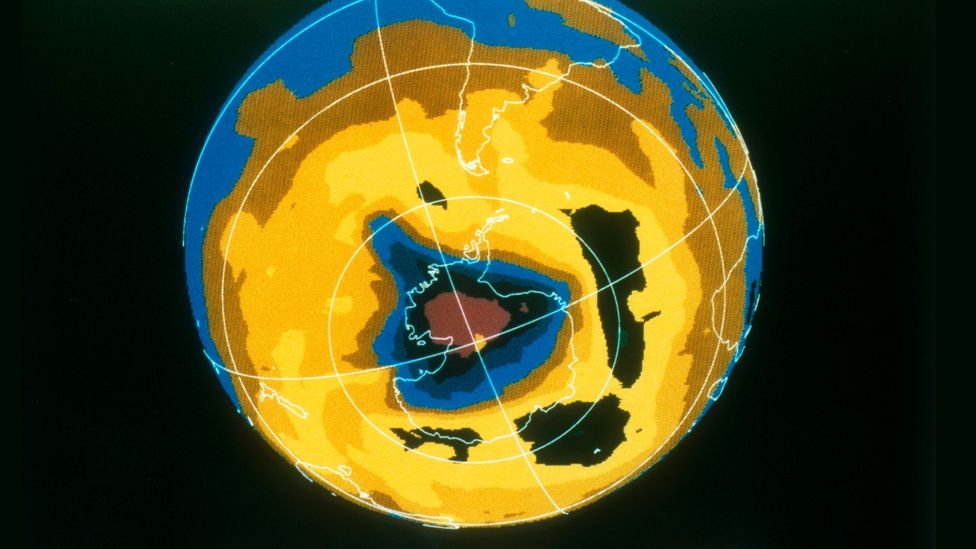
The ozone hole opens above the Antarctic each spring and closes up again over the summer. It stopped growing in the 1990s and has been shrinking ever since (Credit: Getty Images)
In that location are also activities whose impact we don't yet fully empathise but might pose risks, like rocket launches and sulfate geo-engineering – the idea we can stave off the worse effects of global warming by pumping droplets into the stratosphere to cool the climate, by causing sunlight to exist reflected off those aerosol particles.
"Information technology'southward really important we practise continue in mind the lessons learned from the ozone pigsty story and brand sure we're constantly aware of what'due south going on in the stratosphere," says Revell. "The risk is we cause some unforeseen damage to the ozone layer if such assessments are non carried out in advance."
There's a trend to compare the ozone hole to climate change, yet while the Montreal Protocol does demonstrate nosotros can tackle large ecology problems the comparison only goes so far. CFCs were a replaceable component of a few products. The telescopic of climate change makes it considerably more than difficult to address; fossil fuels are pervasive throughout our lifestyle, they cannot be replaced near every bit easily and most governments and manufacture have, thus far, resisted reducing fossil fuel emissions.
For Shanklin, it'south sad to accept wound up where nosotros are, stalled on climate activeness, still talking about what nosotros might do, when there'due south such a articulate example to learn from.
"The creation of the ozone hole showed how rapidly nosotros can modify our planetary environment for the worse and that lesson is not really being taken seriously plenty by the politicians," says Shanklin. "Climate alter is a bigger trouble, to be off-white. Just that doesn't absolve the politicians of responsibility for making the necessary decisions."
--
Bring together ane million Future fans by liking united states of america on Facebook , or follow us on Twitter or Instagram .
If you liked this story, sign up for the weekly bbc.com features newsletter , called "The Essential Listing" – a handpicked selection of stories from BBC Hereafter , Civilization , Worklife , Travel and Reel delivered to your inbox every Fri.
Source: https://www.bbc.com/future/article/20220321-what-happened-to-the-worlds-ozone-hole
0 Response to "What Happened Once Is Happening Again"
Post a Comment